Administrative Regulation: Satisfactory Academic Progress
Regulation Number: 5.1.1
Eastern Wyoming College (EWC), as a participant of the U.S. Department of Education (ED) Title IV program, has established requirements for enforcing standards of Satisfactory Academic Progress (SAP). The SAP standards apply to all applicable forms of financial assistance programs including the Federal Pell Grant, FWS, FSEOG, Direct PLUS loans as well as assistance from the State of Wyoming. The College will determine what institutional funds will be affected by the student’s SAP status.
Definitions:
- SAP – Satisfactory Academic Progress
- FWS – Federal Work-Study
- FSEOG – Federal Supplemental Educational Opportunity
- Direct PLUS Loan – Direct Parent Loan for Undergraduate Student
Regulatory Compliance
The institution abides by the SAP process for all degree seeking students, regardless of whether the student receives Title IV or not. A student’s entire academic record will be reviewed and evaluated for SAP whether financial aid was received or not. The process to review Financial Aid SAP eligibility will be the same for all students evaluated. All coursework, including coursework for which a college has offered academic amnesty must be included in the review process. The College will notify financial aid applicants of their SAP status. A student is considered a financial aid applicant if they complete the Free Application for Federal Student Aid (FAFSA) or if they are offered funding to assist in educational costs through the Financial Aid Office.
The regulations require the measurement of cumulative GPA (quantitative), rate of progression (qualitative), and maximum time frame. A change of program does not reset the SAP calculation. EWC students are making SAP if they consistently:
- Maintain a cumulative GPA of at least 2.00
- Complete 66.6667% of attempted credits *
- Do not attempt more than 150% of the number of credits required to complete the program in which the student is enrolled.
- As an example, for those enrolled in CSMO AAS, it takes 76 credits to graduate. The maximum time frame for this program would be 114 attempted credits (76 x 150%)
*Attempted credits are any credits for which the student enrolled, whether or not the student received federal financial aid. Attempted credits include withdrawn, incomplete, failed, remedial, and repeated coursework. Transferred credits accepted by EWC are included in the cumulative credits attempted and completed. The table below illustrates how graded courses impact Financial Aid SAP.
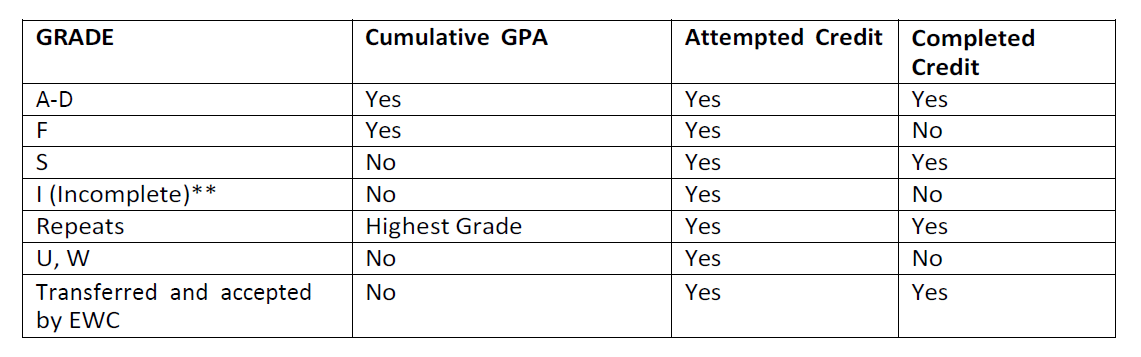
Table showing how different grades (A-D, F, S, I, Repeats, U, W, Transferred to EWC) affect cumulative GPA, attempted credit, and completed credit with corresponding yes/no responses.
**When completed OR the student receives an F grade due to failure to complete the coursework as required, the new grade is used to calculate SAP when calculated at the end of the Spring semester. The updated letter grade is treated per the table above when SAP is recalculated.
Process
All students enrolled in Title IV eligible coursework are monitored for financial aid satisfactory academic progress (SAP) at the end of each Spring semester. Students who reach or exceed the maximum time frame and/or have less than a 2.00 cumulative GPA and/or have less than a 66.6667% completion rate are no longer eligible for federal Title IV financial aid and any state or institutional awards that requires SAP. These students receive an ineligible or terminated (TRM) status when GPA and/or pace requirements are not met. The student receives a maximum time frame (MAX) when they have reached or exceed the maximum time frame. Students with Title IV aid are notified via email they are not eligible for federal financial aid. The email includes information about how to regain eligibility and the appeal process.
Students may also view their Financial Aid SAP status in Self Service, even if they do not receive Title IV aid.
Ineligible and Probation Students
Students with TRM or a probation status are monitored at the end of each academic term of enrollment to determine if they are now making SAP OR adhering to the terms of their probation. Students with a FAFSA on file are notified via email of their newly calculated SAP status. The student’s most recent SAP status is also viewable in Self Service Financial Aid.
Transfer Students
Transfer students with transfer credits that total the number of credits needed to complete their degree or certificate must submit an SAP Appeal when the FAFSA for the upcoming academic year is received to complete the financial aid process. This is done to ensure that the student’s credits required for the degree/certificate can be completed within the max time frame. Students who cannot complete their degree before they reach the maximum time frame are placed on Probation with an Academic Plan for the estimated number of terms to complete the degree/certificate.
Appeal Process
Students have the right to appeal their SAP status if they have mitigating or unusual circumstances they believe prevented them from maintaining or achieving SAP. Mitigating circumstances include, but are not limited to: illness, death in the family, family emergency, catastrophic incidents, divorce, births, etc. The student may submit a letter of appeal (SAP Appeal Form) and relevant supporting third-party documentation to the Financial Aid Office for review. Appeals without appropriate third-party documentation (death certificate, hospital bill, etc.) may be denied, depending on circumstances surrounding the appeal.
Denials
If the appeal is denied, the student may regain financial aid eligibility by meeting the SAP requirements in a subsequent semester of enrollment. The student will remain on TRM status for future terms until the SAP requirements are met. Students with a TRM status who are also exceeding the maximum time frame credit allowance cannot regain Title IV financial aid eligibility without an appeal.
If the appeal is denied, the student may remain enrolled by self-paying for the billed charges and can regain financial aid eligibility by meeting the SAP requirements at some point while they are still degree-seeking. The student will remain on ineligible status for future terms until the SAP requirements are met. Students with an ineligible status who are also exceeding the maximum time frame credit allowance cannot regain Title IV financial aid eligibility without an appeal.
Approvals
If the appeal is approved, the student will be required to follow their degree audit and must successfully complete all attempted credits and earn a term GPA of 2.0 or higher. Students with a Probation with an Academic Plan status remain eligible for financial aid as long as they continue to meet the stated standards. The student will be monitored at the end of each semester and will be moved to Good Standing if the student meets SAP before the student reaches 75% of the maximum timeframe. Unless the student regains good standing, the student will continue on Probation with an Academic Plan as long as they do not reach maximum timeframe.
Students on Probation with an Academic Plan who fail to meet SAP at the end of the semester AND fail to meet the requirements of their Academic Plan are not eligible for federal financial aid. Students may also appeal for an extension due to meeting or extending the maximum time frame. Mitigating circumstances may include changing of the academic program. A student’s appeal for an extension must include an Academic Plan. If approved, the student will receive an Extension SAP status. Students with an Extension status must adhere strictly to the Academic Plan. Deviation from the Academic Plan will put the student on Maximum Time Frame SAP status and the student will not be eligible for Federal Title IV financial aid.
Financial Aid SAP and EWC SAP
Financial Aid Office SAP policy may differ from the academic SAP policy of EWC. While a student may be considered in ‘good standing’ with EWC, they may not be making Financial Aid SAP.
Federal Pell Grant Duration of Eligibility
Receipt of Federal Pell Grant has a lifetime limit of 12 full-time semesters or its equivalent.
Federal Direct Loan Limits
Federal Direct Loans have annual and aggregate limits set by the U.S. Department of Education.
Note: Students may not appeal Pell or loan annual or aggregate limits. View
aggregate limits at the Federal Student Aid website.
Transfer Students
Students who transfer to EWC from other post-secondary institutions may be eligible for federal aid in accordance with established U.S. Department of Education and EWC guidelines. Hours transferred from any prior institution(s) are counted in both attempted and completed hours for Satisfactory Academic Progress and Maximum Time Frame calculations.
Students who transfer to EWC mid-year and who used federal aid at another college during the same academic year will have their federal aid eligibility reduced as federally mandated annual maximums must be considered.
SPECIAL NOTE: If you are transferring to EWC between the Fall and Spring semesters, please be aware that financial aid does not “automatically” transfer from one school to another. The amount and type of aid offered may differ due to variations in the schools’ costs of attendance, funding available, and academic requirements. Annual and aggregate federal aid limits apply. Students must add EWC’s school code, 003929, to their FAFSA in order for EWC to evaluate their federal aid eligibility. Official transcripts from all previous institutions must be submitted to EWC to determine credits for Maximum Time Frame calculations. Contact the EWC Financial Aid Office for assistance with the transfer process.
References: Board Policy 5.1 – Financial Aid and Scholarships
Original Adoption Date: 10/21/24
Revision Date(s): 03/23/2026
Date Reviewed, no change: